ABOUT VERSION FRANCAISE
LINKS
Publications
- - La vocalisation : une approche du timbre des instruments du quatuor à cordes dans le discours des luthiers et des instrumentistes, Master Thesis → (erratum of p. 162)
- - Sounding "round”, "bright", “Oooh” or “Aaah”: On the use of phonemes to describe the timbre of string quartet instruments, published in Proceedings of Timbre Montréal 2026
Associations
- - The Makers' Forum
- - Collectif Lutherie Montreal
- - Association de Luthiers et Archetiers pour le Développement de la facture instrumentale
Education, experience
ABOUT VERSION FRANCAISE
Leïla Barbedette obtained her Diploma of Arts and Crafts in Violin Making in 2006 at the National School of Violin Making in Mirecourt (France).
She completed her training with François-Joseph Pommet, where she worked as an assistant for five years in Reims (France) before crossing the Atlantic to broaden her knowledge in Montreal (Québec, Canada), in the Wilder & Davis workshop. In addition to her work repairing, restoring and maintaining the instruments of the string-quartet, Leïla has made modern and baroque violins, violas and cellos, played by student and professional musicians in Europe and Canada. She regularly participates in luthiers' meetings, symposiums and professional internships that allow her to continue to enrich her training and experience. She is a founding member of the Maker's Forum, the association of canadian violin and bow makers, she was its secretary from 2018 to 2021; and non-resident member of the Collectif Lutherie Montréal.
Leïla started her own business in 2018 to focus primarily on instrument making, but also to resume her music studies at the University of Montreal and further her classical singing practice. Through various courses, she explores the links that can be established between singing and instrument making. In 2022, she began research on the perception of string quartet sounds in relation to the singing voice, under the supervision of Caroline Traube, which led her to pursue a master's degree in musicology, exploring various ways of talking about the sounds of instruments, particularly in the context of sound adjustments.
In January 2026, she will continue her research as part of a joint PhD programme with Caroline Traube at the University of Montreal and Claudia Fritz at Sorbonne University. This stage, which will include field experiments and acoustic analyses, will enable a more direct link to be established between the language used by luthiers and musicians and the acoustic reality described. During a sound adjustment session, luthiers and instrumentalists discuss the timbre of the instrument, using words that are personal to each of them. The aim of this research is not to create a universal language, but to develop new natural intelligence tools to better decode the intuitive language of the various interlocutors. This research is being conducted with the support of public research organisations in Quebec (FRQSC) and Canada (SSHRC).
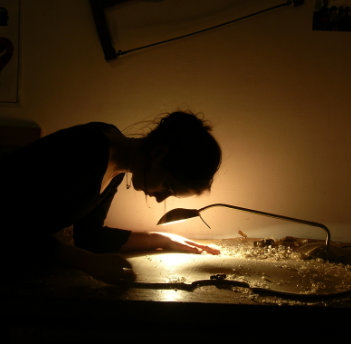
To carry out this research, a computer regularly takes pride of place on the luthier's workbench, as she has had to put her instrument-making activities on hold. However, the wood and tools are always close at hand and come back to life during various repairs, which allow Leïla not only to keep her hand in, but also to feed each of her areas of activity (violin making, singing, research) with the knowledge she has acquired in the others.
LINKS
Publications
- - La vocalisation : une approche du timbre des instruments du quatuor à cordes dans le discours des luthiers et des instrumentistes, Master Thesis → (erratum of p. 162)
- - Sounding "round”, "bright", “Oooh” or “Aaah”: On the use of phonemes to describe the timbre of string quartet instruments, published in Proceedings of Timbre Montréal 2026
Associations
- - The Makers' Forum
- - Collectif Lutherie Montreal
- - Association de Luthiers et Archetiers pour le Développement de la facture instrumentale
Education, experience